Prescribe or Pass: The PoP Pod
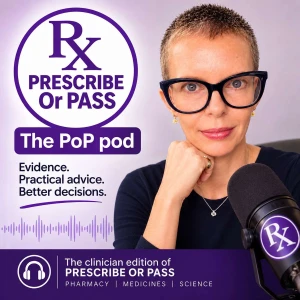
Prescribe or Pass: The PoP Pod is the clinician-focused edition of Prescribe or Pass, an evidence-based podcast for pharmacists, pharmacy students and other health professionals who work with medicines. Hosted by Australian pharmacist, educator and science communicator Kate Thomas, each episode examines a single medicine, condition or clinical concept and explains not only what clinicians do but why. Topics include practical pharmacology, clinical reasoning, patient counselling, common misconceptions, adverse effects and ethical questions from real-world practice. Some episodes stand alone, while others form structured educational series with reflective questions that support continuing professional development.
Episodes
Why Does My Vyvanse Feel Different Before My Period? ADHD, Hormones & Perimenopause
Does your ADHD medication seem to work brilliantly for most of the month and then suddenly feel less effective before your period?In this bonus episode of Prescribe or Pass: The PoP Pod, pharmacist Kate Thomas explores the fascinating and still under-researched relationship between ADHD, stimulant medication and female hormones.We look at how oestrogen and progesterone may interact with dopamine,
Nausea and Vomiting: Choosing the Right Antiemetic for the Cause
Nausea and vomiting are common in palliative care but they are not diagnoses in themselves.In this episode, we look at how to work backwards from the symptom and ask what is actually causing it. Gastric stasis, opioids, constipation, metabolic disturbances, vestibular problems, raised intracranial pressure and bowel obstruction can all cause nausea and they do not all need the same treatment.We un
Breathlessness in Palliative Care: Why Morphine Can Help When Oxygen Doesn’t
Why can someone feel profoundly breathless even when their oxygen levels are normal? And why might morphine help more than oxygen?In Episode 4 of our palliative care series, we unpack the difference between breathlessness and hypoxaemia, why oxygen is not always the answer, and how low-dose opioids can reduce the distress and sensation of struggling to breathe.We also cover reversible causes of br
Opioids Without the Fear: Morphine, Oxycodone, Fentanyl and More
Opioids are some of the most important medicines in palliative care and some of the most misunderstood.In this episode, we take a practical deep dive into morphine, oxycodone, hydromorphone, fentanyl, buprenorphine and methadone, including how their potency differs, what changes in renal impairment, and why opioid conversion is never just simple arithmetic.We also look at opioid rotation, breakthr
Pain in Palliative Care: It’s Not Just About Morphine
Pain in palliative care is rarely as simple as “give more morphine.”In this episode of Prescribe or Pass: The PoP Pod, we start with the most important step: working out what kind of pain the patient is actually experiencing.We explore nociceptive, neuropathic, visceral and bone pain, and how the likely mechanism should guide treatment. We also look at where paracetamol, NSAIDs, opioids and adjuva
Palliative Care Is Not Just End-of-Life Care
Palliative care is often misunderstood as the point where active treatment stops and “nothing more can be done.” But that is not what modern palliative care looks like.In this first episode of our new palliative care series, we unpack what palliative care actually is, when it should begin, how it can sit alongside disease-directed treatment, and why referral does not mean giving up.We also look at
Beyond MHT: Supplements, Strength and What Actually Matters
In the final episode of our MHT series, we look beyond hormones and into the booming menopause wellness market.Do phytoestrogens, soy isoflavones, red clover, wild yam, black cohosh, magnesium, collagen and creatine actually help, and how do they compare with prescribed MHT?We also unpack the difference between soy foods and concentrated phytoestrogen supplements, why wild yam cream is not progest
MHT Episode 7: MHT Risks, Contraindications & the WHI
MHT is often discussed as either “safe” or “dangerous” but the real clinical picture is far more nuanced.In Episode 7 of our menopause series, we unpack the major risks associated with menopausal hormone therapy, including breast cancer, venous thromboembolism, stroke and cardiovascular disease, and explore how age, timing, route of administration and the specific hormone regimen all influence ris
Bonus Episode: Centanafadine: The New Triple Reuptake Inhibitor for ADHD
Just when we thought the ADHD series was finished, the FDA approved a brand-new ADHD medication.Centanafadine, FDA approved in the US as Simtriyo, is a once-daily triple reuptake inhibitor that affects dopamine, noradrenaline and serotonin, giving it a mechanism unlike the ADHD medicines we currently use.In this bonus episode, we look at how centanafadine works, why serotonin is part of the pictur
MHT Episode 6: Vaginal Oestrogen, Prasterone and Genitourinary Syndrome of Menopause
Genitourinary syndrome of menopause, or GSM, is common, chronic and often under-recognised. In this episode, we look at how declining oestrogen affects the vulva, vagina, urethra and bladder and why symptoms can include much more than vaginal dryness.We explore the role of low-dose vaginal oestrogen, including how it restores the vaginal epithelium, glycogen, Lactobacillus populations and an acidi
MHT Episode 5: Testosterone in Menopause. Who Needs It, What It Does and What It Doesn’t
Testosterone has become one of the most talked-about hormones in menopause care, but its evidence-based role is more specific than the hype sometimes suggests.In Episode 5 of our MHT series, we look at what testosterone actually does in women, how levels change with age and menopause, and the one clear evidence-based indication for treatment: hypoactive sexual desire disorder, or HSDD.We discuss h
MHT Episode 4: Progesterone, Progestogens and Protecting the Endometrium
Oestrogen may get most of the attention in menopausal hormone therapy, but if a uterus is present, progesterone, or another progestogen, has a crucial role to play.In Episode 4 of our MHT series, we look at why endometrial protection matters, the difference between progesterone, progestogens and progestins, and how cyclic and continuous combined MHT regimens work.We also cover micronised progester
MHT Episode 3: Oestrogen: Patches, Gels and Tablets
Oestrogen is the headline act in menopausal hormone therapy, but the way it is delivered matters.In this episode, we explore the differences between oral and transdermal oestrogen, including patches, gels and tablets. We look at absorption, first-pass metabolism, clotting risk, practical counselling points, dose considerations and why one formulation may suit a patient better than another.Using ou
MHT Episode 2: What MHT Can, and Cannot, Treat
Menopausal hormone therapy can be transformative, but it is not a cure-all.In this episode, we look at the symptoms MHT treats most effectively, including hot flushes, night sweats and genitourinary symptoms, as well as the areas where the benefits are less predictable, such as sleep, mood, brain fog, joint pain and sexual function.We also unpack what MHT should not be expected to do. It is not a
MHT Episode 1: Perimenopause, Menopause and What the Hormones Are Doing
What is actually happening to hormones during perimenopause, and why can symptoms feel so unpredictable?In the first episode of our new eight-part series on menopausal hormone therapy, pharmacist Kate Thomas explains the physiology behind the menopausal transition, including changes in oestrogen, progesterone, FSH, ovulation and ovarian reserve.We also look at why hormone blood tests are often unh
Episode 8: ADHD Myths Every Clinician Should Know
ADHD is overdiagnosed. Everyone is a little ADHD. Stimulants are addictive. Medication changes personality. Children grow out of it. Sugar, phones, or even the gut microbiome, cause ADHD.In the final episode of this eight-part series, pharmacist Kate Thomas examines some of the most common myths surrounding ADHD and its treatment.We look at what the evidence actually tells us about diagnosis, stim
Episode 7: Managing ADHD Medicines in Real Life | Practical Counselling for Clinicians
What happens if a patient forgets their ADHD medicine?Should they take weekends off?Can they exercise? Drive? What about pregnancy, university, shift work, appetite, weight loss or the ongoing medicine shortages?In this practical episode of Prescribe or Pass: The PoP Pod, we move beyond pharmacology and into the real-world questions pharmacists, doctors and other clinicians are asked every day.We
Episode 6: Beyond Stimulants Understanding Atomoxetine, Guanfacine and Clonidine
Stimulant medicines like methylphenidate and Vyvanse often dominate conversations about ADHD, but they’re only part of the story.In this episode of Prescribe or Pass: The PoP Pod, we take a deep dive into the three main non-stimulant medicines used to treat ADHD: atomoxetine, guanfacine and clonidine.You’ll learn how these medicines work, why they’re prescribed, who they’re best suited for, and wh
Episode 5: Dexamphetamine & Vyvanse Explained | How They Work and Why They’re Different
If Vyvanse is converted into dexamphetamine… why do the two medicines feel so different?In Episode 5 of our ADHD medicines series, we unpack the science behind the amphetamine family and explain one of the most fascinating concepts in pharmacology: the prodrug.Learn how lisdexamfetamine (Vyvanse) is converted into active dexamphetamine inside red blood cells, why this creates a smoother and longer
Ritalin, Ritalin LA and Concerta: Same Drug, Different Delivery
Ritalin, Ritalin LA and Concerta all contain methylphenidate but they are not interchangeable versions of the same medicine.In this episode, we compare immediate-release methylphenidate, Ritalin LA and Concerta, including how each formulation releases the medicine, how long it may last, and why the same number of milligrams can feel very different.We also cover switching between formulations, Aust
Understanding Methylphenidate: How It Works, What to Expect and What to Monitor
Methylphenidate is one of the most commonly used medicines for ADHD, but understanding it requires more than knowing a list of brand names.In this episode of Prescribe or Pass: The PoP Pod, pharmacist Kate Thomas explains how methylphenidate works, why immediate-release and modified-release products behave differently, and what patients may realistically notice when treatment is effective.She also
Ritalin vs Vyvanse: How Clinicians Choose ADHD Medications
Why is one patient prescribed Ritalin while another receives Vyvanse? Is one medication “stronger” than the other? Does it mean their ADHD is more severe?In this episode of PoP Pod, we explore the clinical reasoning behind ADHD medication selection and explain why there is no one-size-fits-all approach.You’ll learn how clinicians individualise treatment by considering factors such as symptom profi
ADHD Series | Episode 1 What Actually Is ADHD?
ADHD is one of the most talked about and misunderstood conditions in healthcare.In the first episode of our ADHD series, we start with the foundations.What actually is ADHD? Why is it considered a disorder of executive function rather than simply a problem with attention? What roles do dopamine and noradrenaline play? How is ADHD diagnosed in Australia, and why is there no blood test or brain scan